read time: approximately 6 minutes
This week
- On Sun, Jul 27, my parents and brother, who insisted on “dropping me off at school,” 🙂 flew to Amsterdam with me. We arrived on Mon, Jul 28
- We have been in Amsterdam for the week!
Last Sunday we left the States to physically journey to Norway. We’ve spent the last week in Amsterdam and chose the city only because it offered the cheapest flight from Denver. Amsterdam isn’t so bad of a city to be a tourist in, though. The van Gogh museum is here, as is the Tony Chocolonely super store. And the Amsterdam Pride Parade was happening while we were in town too. So there were interesting things for us to do for the week. Turns out, surprises abound, and the home we’re staying in is next door to the Frank home (yup, Anne Frank) and where they lived before having to go into hiding in the Secret Annex.
When we were still in the States and got the housing guide that detailed local grocery stores and restaurants, it included information about a park across the street with a statue of Anne Frank and said that the house we’re staying in is adjacent to the Frank house. I was confused, though, because when I looked at a map, where we’re staying and what I understood to be the Anne Frank house were not the same place on the map. But the housing guide was written in French so I thought, maybe my French is rusty and I’ve just misunderstood.
But then I went on a run on our second day in town and noticed some stumbling blocks, stones in the ground in front of homes where Jewish families once lived. The stones, mostly made in Berlin, Germany, memorialize the last home of Jewish families before they were deported and eventually murdered—or survived—Nazi death camps. I had seen them before in Germany when traveling with my husband and his family on an ancestral tour. As I finished out my run I wondered if there might be any stumbling blocks on our street, and sure enough, next door are the four stumbling blocks from the Frank family home (see image).

That’s when I understood that there are two homes—and that my French wasn’t so rusty after all—and realized why there’s a statue of her in the park. We are staying in the building next to the Frank house that was their home between their move from Frankfurt, Germany (when she was 4 years old) and the Secret Annex (when she was 13). Upon making this realization, I was overwhelmed with sadness thinking about the streets Anne Frank strolled down where I’ve also walked, the park across from the apartment building she played in that now bears her statue, the shops she visited that I must’ve passed by myself. I’ve led myself to believe that their apartment might even have the same floor plan as the one we’re staying in (fact check: actually, it’s highly likely as we’re staying at Merwedepelin 31-2 and she was at Merwedeplein 37-2; the first number is the house number and the second number is the apartment number). Having read her diary as a high school student, read it with high schoolers as a teacher, and read the graphic novel adaptation, I have the sense of a parasocial relationship with her: I feel like I know so much about her from her private writings that her dad fought to have published once he came back to Amsterdam after he was liberated from the death camps and learned he was the only surviving member of his family.
And then we went on a walking tour that featured the Frank Family and how the Netherlands fared and fell in WW2. There was a German mom and her young daughter—about 13 or 14 I would say—with us on the tour. When our Dutch tour guide mentioned the German war machine marching into the Netherlands, I happened to catch the daughter’s face—not on purpose. She scrunched up her nose and mouth and tilted her head slightly, as if to note that she was uncomfortable with the association. What I read in this look was that she is German and so were the Nazis and yikes we’re talking about her country. Our tour guide let us know that Anne Frank would have been 96 years old this year had she not died at Bergen-Belsen. That’s not that old. WW2 and the Holocaust are not that far away.
This led my mind to another spiral, thinking about reactions that some people have in the States to talking about enslavement. I thought about the history of enslavement and how the treatment of those with minoritized identities shapes our contemporary society. And I thought about how this shapes the teacher preparation that is my daily work. In my preparation classes, we begin with the idea that our country is not one that has achieved equity and justice for all peoples, how schooling reflects this idea, and what we must do to shift our schooling so that all students can be treated with justice.
I wondered, what is it like to prepare teachers in Europe, with this backdrop of the Holocaust and the attempted extermination of not just Jews, but also those who are disabled, the Roma population, and gay and lesbian and queer members of our society. In our societies, people are marginalized because others are doing the marginalization; we have been taught to marginalize others. This shows up in schools in the ways we treat students and what we value in the classroom, from curricula, to pedagogy, to assessment. To what extent do these historical contexts play a role in understanding who we are, our values, our teaching, and our teacher preparation? I’ve done a fair amount of thinking about this in the context of the United States. I’d like to continue to think about this question as I move to Norway and begin to meet teachers and learn about education there.
To what extent do these historical contexts play a role in understanding who we are, what our values are? Our teaching, and our teacher preparation?
A final note. On our tour, we walked by the Secret Annex house and our tour guide pointed out an old picture of where the Franks lived before the Secret Annex—because we had told our tour guide that we are staying next door to their house. And I could see how the contemporary street is the same, but changed. The biggest difference is the trees. There were no trees that lined the park when Anne Frank lived on this street (see first picture below). Which means that the trees were planted sometime after she moved, was deported, and was killed. But I had just assumed they had been here for a long time because they’re pretty tall. Things can change. And things do change.
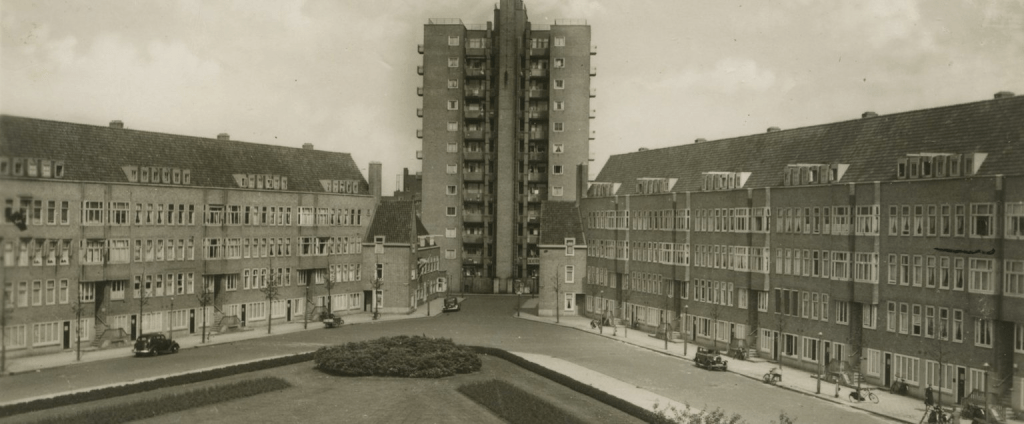
Photograph of apartment buildings on Merwedeplein, with skyscraper apartment building in the background and park in the foreground. The Frank family lived in the building on the right, closest to the right edge of the photograph.
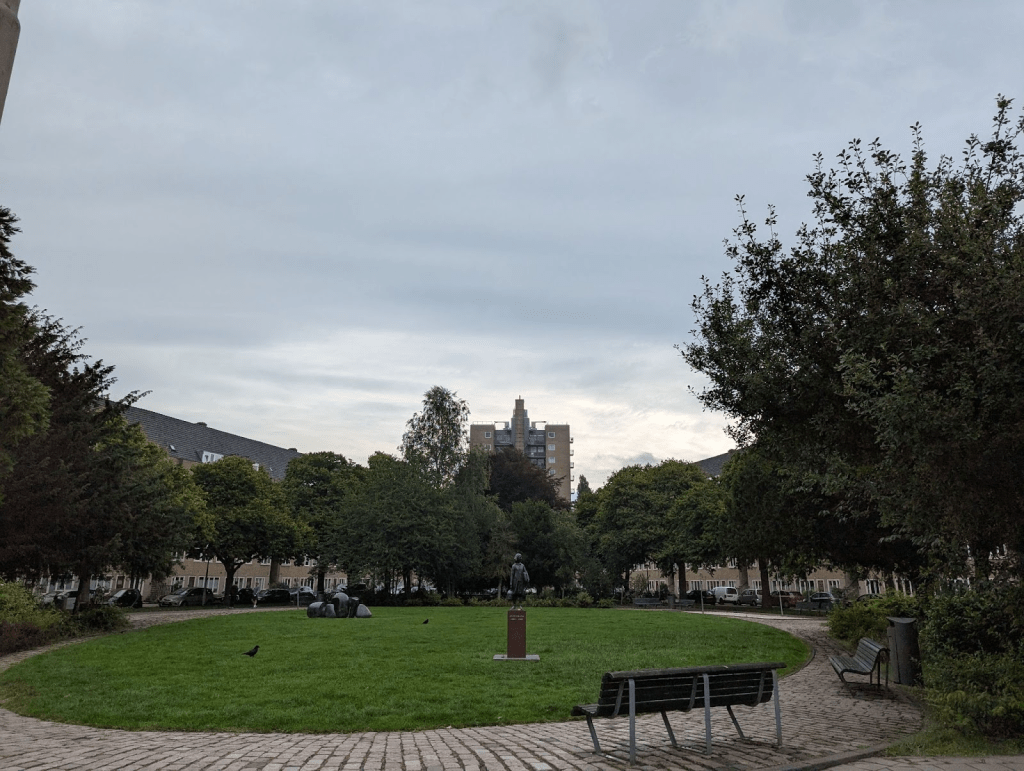
Picture taken Aug 03, 2025 of the park at Merwedeplein. The skyscraper can still be seen in the background. In the middle ground is a statue of Anne Frank. It’s hard to see the apartment buildings on Merwedeplein because of the trees.
 Naitnaphit Limlamai