Read time: approximately 11 minutes
This week was Vinterferie (Winter Break)! I traveled to Tromsø in North Norway!
- Tuesday, 17 February flew from Oslo to Tromsø. It is north of the Arctic Circle and the farthest north I have ever been, not just in Norway but in my life! Did a yoga class at the University of Tromsø.
- Wednesday, 18 February we (some other Fulbrighters and I) walked around downtown, had reindeer sausage and locally made fishcakes (yum), went to the Polar Museum, checked out the library, went to the sauna and also did the cold plunge (into Arctic waters!), and then did our post-sauna at the world’s northernmost McDonald’s. My first McDonald’s in Norway!
- Thursday, 19 February we rented snowshoeing equipment (shoes and poles) and went snowshoeing! Even snowshoed along the coast into the Tromsø Museum for a lecture on whales in the ocean and how human-made sounds from boats, tourism, etc affect them. Did a late-night snowshoeing trek to chase the Northern Lights. And we saw them.
- Friday, 20 February returned my snowshoeing equipment and I went back to the Tromsø Museum to check out the exhibits on the Samí peoples, the Indigenous peoples of the region. Had reindeer soup for lunch. Wrote and sent postcards. Flew to Oslo and took the train home!
I don’t normally include pictures in my blog (it just seems like a lot of work), but I want to show you two this week
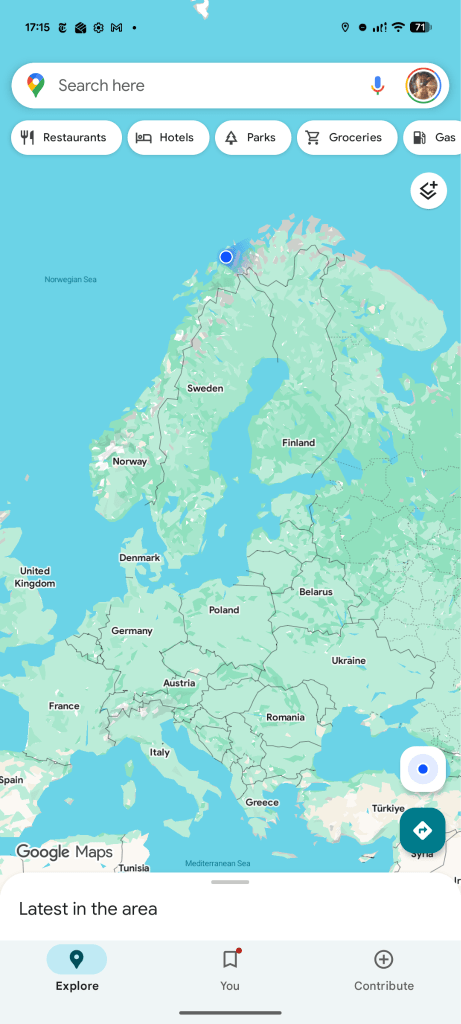
The picture on the left is a screenshot I took when I landed in Tromsø this week. Pretty wild, right? I was north of the Arctic Circle! So far North! I was so far North that when I tried to scroll up on Google Maps I could go no farther up! Like, I hit the top of the Google map!
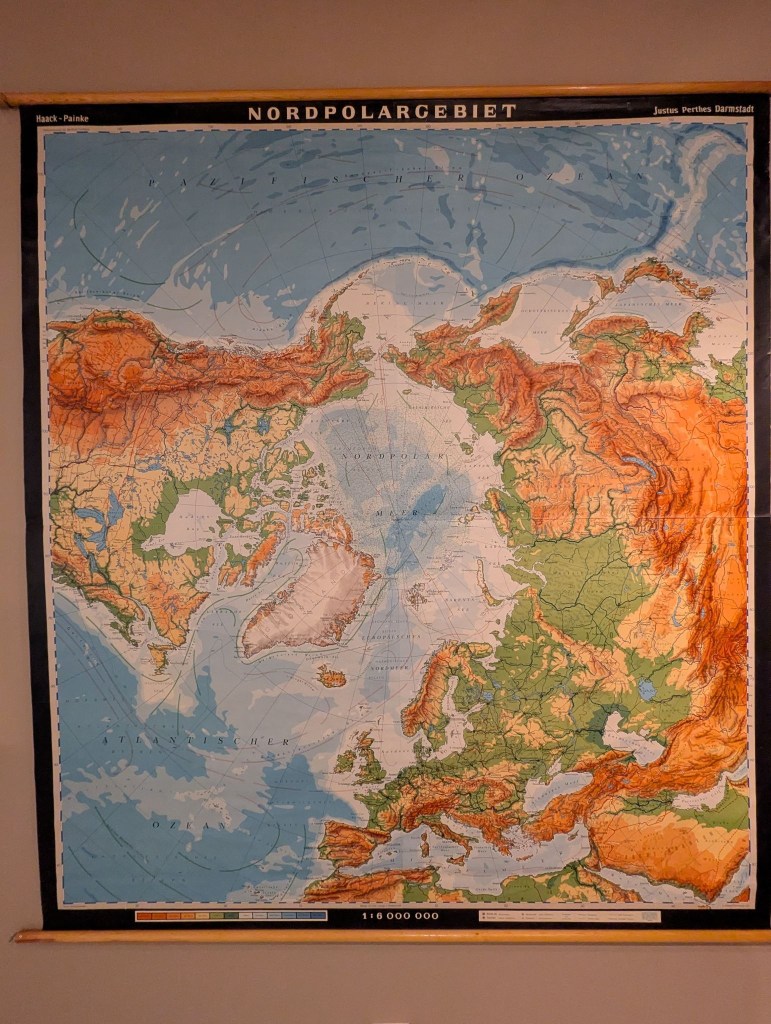
The picture on the right is a picture of a map you might find in an old classroom—one of those that you pull down from a container hanging above a blackboard. I’ve seen this world map many times since I’ve lived in Norway but it never fails to disorient me. Because Alaska is upside down.
I am sharing these two pictures with you because my mind has been blown these last two weeks in considering my perspective on the world.
Last week I was at Kruseløkka Ungdommskole in Sarpsborg co-teaching with some teachers-in-training. We were co-facilitating my workshop on Monsters to go along with the writing fantasy and sci-fi stories unit the 10th graders just finished. In the second lesson, one of the teachers-in-training wanted to take the lead in talking about Godzilla. A segment of the lesson entails talking about one of the images of Godzilla, which has him rising out of the Pacific Ocean as war ships and planes attempt to surround him to bring him down. In the bottom right corner of the image is an aircraft carrier.
I have noticed this ship, but didn’t think anything more about it. When the teacher-in-training was asking students what they saw in the image and one student mentioned “a ship,” the teacher-in-training asked him to be more specific. The teacher wanted the student to say “aircraft carrier.” And then the teacher told them that only like 8 countries in the world have aircraft carriers.
I did a double take. Say what? Not every country in the world has aircraft carriers? I have no idea why I thought that they did, and I don’t think I’ve ever actually thought about the specific military vessels in other countries. Like, does not every country have tanks? Honest question. My mind was so blown. Not just by the idea that not every country has aircraft carriers, but also by the idea that I thought every country had aircraft carriers. Maybe I didn’t actually think that all countries had aircraft carriers, but have just never thought about which countries did until the teacher mentioned it.
That’s perspective, right? Living in Norway has given me many opportunities to view, recognize, and examine ways that I, as an American, have limited perspectives on the world.
Being in North Norway this year kept doing that. Specifically, check again that map on the right: where you are viewing the globe from the top of it rather than from at the equator. For me, this orientation, no matter how many times I see it—and I’ve seen it a lot living in Norway—is disorienting. Because, like I said before, Alaska is upside down. I have to actively train my brain to recognize that I’m looking at the Earth from the top of it.
I’ve seen this map so many times in Norway because this view of the map matters very much to Norwegians. I have mentioned it briefly a few times on this blog, but Norway shares a border with Russia. You can see it, I think, most clearly on that map on the left. You see what’s just east of Finland? That’s Russia. That oil money that Norway uses to fund healthcare and education? Well, they’re moving lots of that money to support Ukraine in fighting against Russia. It’s a big deal that Norway is so close to Russia. From the Norway-Russian border, Russia can launch nuclear weapons at the US. And the flight path for those weapons is over the Arctic, like over the portion of the map on the right.
The perspective of the Arctic map that orients the Earth from above is the most important perspective for many Norwegians, especially for those who live so far North. When I lived in Morocco in the first semester of my junior year and 9/11 happened, an angry professor blocked the flying of the Moroccan flag at half mast in honor of lives lost in the terrorist attacks. Why would we fly it just for the Americans, he asked, when everyday in [insert his country here, I don’t remember which one it was] there is a terrorist attack. I was so naive I didn’t know they occurred on a daily basis in other places. When I lived in Paris my second semester and I was impressed that the high schoolers I worked with knew so much about geopolitics, they asked me what choice they had? They are surrounded by geopolitics and need to know what’s happening because it’s happening all around them. When I asked the students at Kruseløkka Ungdommskole how penpalling with the kids from Brooklyn was going, they said, I think they think we’re stupid. When I asked them why they said that, they said, because they ask us if we know about things like capitalism. Of course we know, the Norwegian students said. Truly, based on some of the questions I get from Norwegian 8th-13th graders, they know so much more about the world than most students I teach in the US. When I expressed fear about the next US presidential election (because I am afraid that Trump will not leave office and it’ll be another January 6 situation), one group told me that they are paying attention and it matters to them too. There is indeed a privilege of isolationism that we can have in the US. It’s been informative and humbling this year to be surrounded by others, from students to adults, who just know so much more about the world than I do.
The other perspective-taking activity that occurred this week was about nature. I have had so much fun in the last week and a half learning two new winter sports: cross-country skiing (yeah Johannes!) and snowshoeing. In that article I just linked for Johannes Høsflot Klæbo, this quotation stands out: “Norway’s success in winter sports is inseparable from the concept of ‘friluftsliv’—open-air living.” Literally free-air-life. Norwegians embrace winter activities, partly because there is so much natural beauty in this country. But it’s not just about living in a naturally beautiful place. It’s that Norwegians place high value and priority on being in that natural beauty.
It’s dark for much of the year and you know how Norwegians solve this problem of darkness? Lighting candles, yes. But during hours when the sun would normally be shining, they get outside and do something active: a walk in the woods, skiing, something like that. I think I’ve written before about how Norway spends the largest amount per capita on hiking and camping gear. They have a network of hundreds of cabins. You just have to be a member and you get a key to all of them. Most families have a hytte, a cottage, usually without electricity or running water, that they all love to go to on the weekends. My university Fulbright contact, who grew up in the States but married a Norwegian, only half jokes that they returned to Norway to live permanently because her husband missed his hytte. These cottages are so far from the road, so you have to hike or ski or snowshoe in. Then you can be all koselig (cozy) in the cabin after you’ve worked to get there.
After learning how to cross-country ski and snowshoe, I get this draw. I already enjoy being active and outside; why would a little snow stop me? Remember, in Norway there’s never bad weather, just bad clothing. So get on your good clothing and get out to enjoy the outdoors—in whatever weather might exist. I had a similar feeling when we lived in Michigan. It’s like, we live in snow and deep dark winter. It’s not going away. I mean, it will, but it takes months. So, let’s just embrace it. What else are we going to do?
The final perspective shift I had this week was from the relationship between humans and nature. Humans are very powerful beings. In the short time we have existed on the planet, relative to how old the planet is, we have managed to destroy a lot of it because of our doing (see: global warming). And also, we are the only species of animal in the existence of Earth that has constructed the means of its own destruction (nuclear weapons and other lethal weapons) in the short time humankind has lived on Earth.
But humans are also really amazing in positive ways. I mean, people live above the Arctic Circle! I was there and witnessed that so many people make their homes so far north. It seems like madness! Yet humans have been living above the Arctic Circle for a long time! We are so adaptive as a species and build homes and construct clothing and find food to account for it being very cold for much of the year. To live so far north, though, one has to also learn how to live with the land, rather than against it. I have been reading The Anthropocene Reviewed and Green talks about how counterintuitive it is that so many people in the States live in the desert, or grow grass that we can’t eat that requires more water than all the corn and wheat grown in the US. Having grown up in Los Angeles and marveling that the city doesn’t even have its own water supply and really shouldn’t exist, this take on living with the land is kind of new to me.
But when I went to the talk at the University on how humanmade sounds are affecting whales, it really hit me that we have to learn to live with the land and not counter to it or in ways that destroy it. A really poignant example is how noise from boats affect how whales communicate with each other. First, water amplifies sound. So a churning boat reverberates immensely underwater, interfering with animals that use sound to locate other animals, including food and family members, even predators. One of our Fulbright hosts in Tromsø is a member of the Coast Guard and when we did our Fulbright Seminar presentations last week on what we’ve been up to, she opened her talk by saying that she drives boats. That’s what she does. But she also cares a lot about how those boats are entering the ecologies of animals that live in the ocean and here are some ways that we can actually coexist. I really appreciated this idea: how can we coexist with our natural surroundings rather than force our human ways onto those surroundings such that we are altering the natural world in destructive and irreversible ways?
When we were waiting for the Northern Lights in the dark and quiet, I was just in so much awe of the natural world and how we have adapted to live in the coldest and darkest, but also the warmest and sunniest, climates. Human beings are incredible. Think of all the adaptations we have made to make an already habitable planet even more comfortable for us! But how are those adaptations affecting the flora and fauna and people who were here before we added ourselves? How can we live with the land in ways that honor it, rather than conquering it?
 Naitnaphit Limlamai